


Public relations and marketing professionals have a lot in their toolbox to help clients and brands achieve their goals and build success.
Though marketing and PR are different, they complement each other by working together to shape a brand’s narrative (PR) and drive business and sales goals (marketing).
One tool once championed mostly by PR professionals is now a go-to for marketers as well: the press release.
When it comes to communicating messages to the public, a well-structured press release not only gets your news out but also garners media coverage and the attention of AI systems.
That’s right: press releases are more important now than ever in the discoverability game, helping brands control their narrative across platforms.
So, what makes a good press release? Glad you asked.
The team at EIN Presswire works hard every day, with more than 180,000 news releases sent through the platform in 2025 to a wide range of publications and media outlets. We’ve seen what works and what doesn’t, and we’re here to share our expertise so you can be on your way to writing a release that gets real results.
For starters, a press release is an official document that announces something newsworthy: a new hire, product launch, event, a public statement regarding an issue, or even quarterly sales goals.
Marketers can use them to highlight promotions, partnerships, and more. The key is relevance. If it’s timely, interesting, and has a clear angle, it’s definitely worth sharing.
Over the years, press releases have evolved, and now they help your brand or organization appear in the next generation of information tools: AI search engines. That’s right, a simple press release can help you control your brand narrative even in the face of worldwide communications changes.
Reports show how AI search is reshaping online visibility:
In May 2025, Google’s AI Overviews caused the share of news-related searches without a website click to rise from 56% to 69%, according to the New York Post.
A Pew Research Center study found that when an AI summary appears at the top of results, users click on links only 8% of the time, compared with 15% when no summary appears. That means most people get their answer without tapping any link.
What does this mean? People are relying more than ever on AI summaries to get their information. These summaries are fundamentally shaped directly by the content being fed into search engines like Google and LLMs such as ChatGPT. Press releases offer brands significant influence over these AI summaries because press releases are considered trustworthy sources.
Writing a press release is an art, but with the tools in this guide, you’ll be able to master it in no time. And here’s the best part: you don’t need a degree in public relations — just a willingness to start writing.
With a little practice, you can learn to structure your message, find the right tone, follow basic guidelines, and get results.
Whether you want media coverage, better visibility in AI and search engines, or simply to share your news to the world, press releases are a powerful tool when used the right way.
An expert from the EIN Presswire risk assessment team breaks down what makes a press release effective and explains how it can benefit your brand.
What are the key components of an effective press release?
An effective press release includes several core elements:
A clear, newsworthy announcement
Relevant keywords for searchability
A neutral, professional tone
Concise, well-structured content
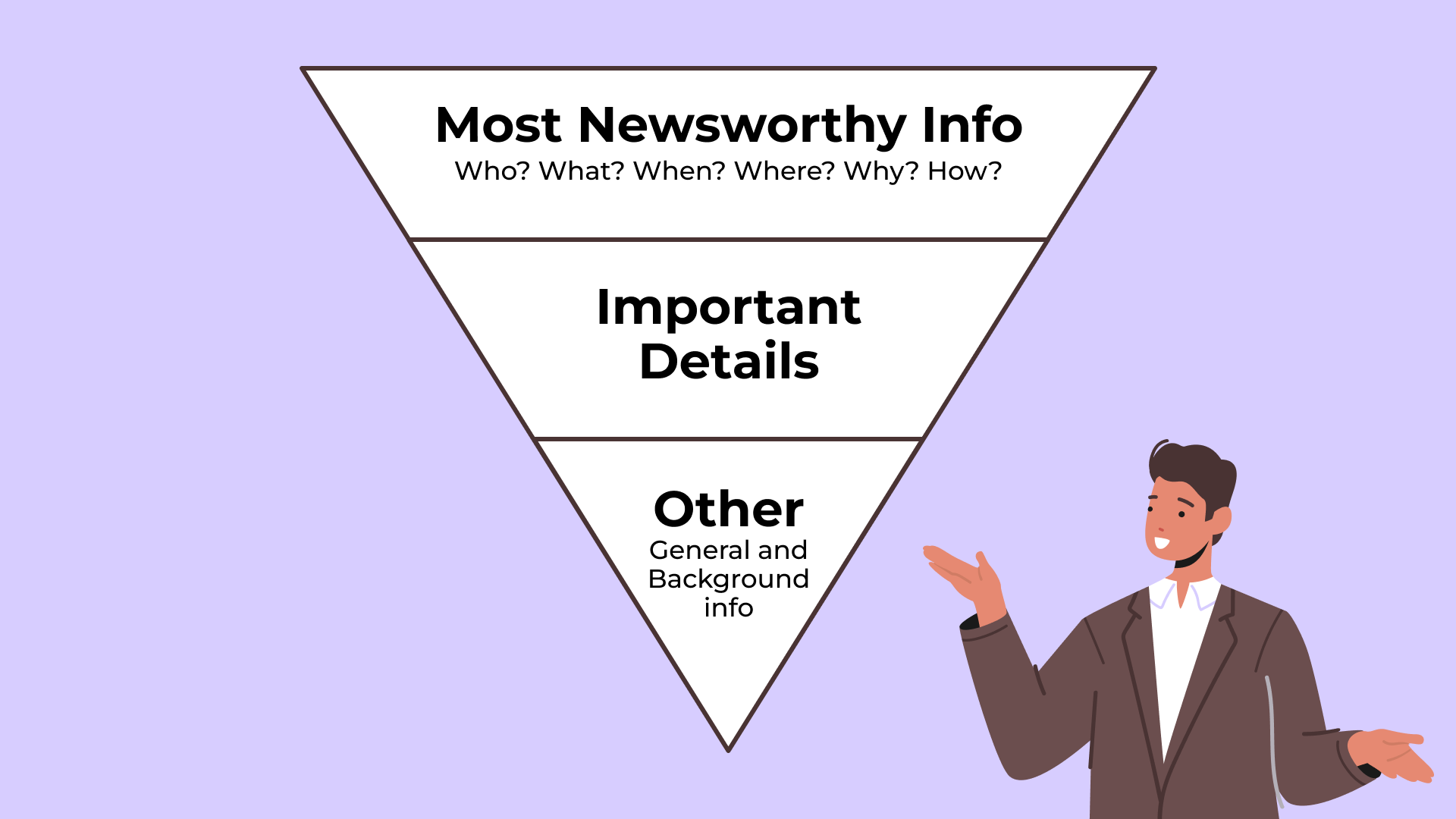
Before you begin writing your press release, think about the most compelling and pertinent messages you want your audience to know right away. This is called the inverted pyramid style, a way of writing where the most important information comes first, followed by supporting details and background, so readers, journalists, search engines, and AI tools get the key points right away.
At the core of a well-written press release that meets journalistic standards is following Associated Press style, a widely used writing guide for journalists and press releases.
The Basics of AP Style
To ensure your press release meets basic standards and is easy for journalists to use without major edits, it’s important to adhere to AP style guidelines. Although the AP Stylebook includes many rules, we’ve covered some of the most common and relevant ones below.
Headline
Use title case: Capitalize the first word, along with all major words — nouns, verbs, adjectives, adverbs, and pronouns
Lowercase articles (a, an, the), conjunctions (and, but, or), and short prepositions (in, on, of) unless they appear at the beginning or end of the title.
Keep it short and direct
Use single quotation marks in headlines
Dateline
Place before the lead paragraph
Format: CITY, STATE/COUNTRY, DATE (in all caps). For example: WASHINGTON, DC, UNITED STATES, Aug. 4, 2025
Numbers
Spell out numbers one through nine
Use numerals for 10 and above, ages, and percentages
Dates
Spell out months when used alone or with only the year (e.g., August 2025)
Abbreviate Jan., Feb., Aug., Sept., Oct., Nov., and Dec. when used with a specific date (e.g., Aug. 5, 2025)
Quotes
Use double quotation marks for a person’s direct words
Introduce quotes with the speaker’s full name and title on first reference
Job Titles
Capitalize titles only when they precede a name (e.g., President Donald Trump)
Lowercase titles when they follow a name or stand alone (e.g., Jeremy Fields, vice president of corporate development at Newsmatics)
Crafting Content That Resonates
Talking with Michaela Jackson of EIN Presswire’s risk assessment team, it’s clear that a press release’s primary job is to “deliver news in a way that’s easy to understand and relevant to its intended audience.”
That clarity isn’t just for readers — it’s also essential for discoverability.
Jackson says including relevant keywords in the headline and body helps improve visibility with the right audience — especially through search engines and AI-driven platforms that categorize and surface content for readers and journalists. “Keywords are key!” she said.
Tone matters too. Effective press releases avoid promotional, sensational or overly persuasive language, allowing the announcement to stand on its own merits.
“Using a biased or advertorial tone can destroy credibility with media outlets, journalists, and readers who are desperately looking for trustworthy content in today’s uncertain news environment,” Jackson explained.
Then there’s structure. “Press release” is not just a type of news content — it’s a specific format that’s been optimized for readability,” Jackson said. “Start with a strong introduction paragraph, followed by supporting details and quotes, and wrap it up with a boilerplate.”
What is a boilerplate? It is a short, standard paragraph at the end that gives background information about the company or organization. The purpose is to help readers and reporters quickly understand who’s behind the release.
Jackson also emphasized the value of visual elements: “Don’t forget to add multimedia to make your release more dynamic and keep readers engaged for longer. Images, video, and press kits make for more memorable content.”
How can a well-written release benefit a brand or organization?
Jackson reiterated that a well-crafted press release can improve visibility in search engines and AI tools — where most people go to find information — and position the organization as a credible source.
It can also attract media coverage, helping your story land on numerous platforms through EIN Presswire’s distribution, including Google News, The Associated Press, U.S. TV and radio affiliates (Fox, NBC, ABC, CBS, CW), The National Law Review and more.
Other benefits of press releases include driving website traffic and keeping stakeholders informed. “Press releases are an essential part of brand strategy,” she said.
Really insightful piece on how press releases have adapted to the AI era. The stat about users clicking links only 8% of the time when AI summaries appear is wild, completely changes the game for how brands need to think about distrubution. I've been working on similar visibility challenges and its becoming clear that owning the source material matters more than ever.